Here is what goes on at sensitivity training at a coed college.
Sensitivity Training - A funny movie is a click away
Thursday, August 02, 2007
Monday, July 30, 2007
Planet to be named after Mumbai boy

A few people have roads named after them, some others have buildings but a boy from Mumbai has a minor ice planet somewhere in the solar system named after him.
“If I look up at the sky, I can always feel there's something out there named after me. That's an excitement and rush like nothing else,” says 17-year-old Rishin Behl.
Rishin's world has acquired a dizzying spin of its own, heady with excitement.
“The exact coordinates will come along with my Intel award,” he says.
It's a project which Rishin presented at an Engineering Fair organised by Intel in the US that has earned him the honour and a scholarship to study electrical engineering in the US.
And that's not all. One of the leading defence forces in the world is now eyeing his innovative design and the details are top secret.
“I can't talk about it right now,” says Rishin.
It is this piece of equipment that has earned Rishin his place in the universe so to speak.
A seismograph, which is used to measure the intensity of an earthquake, much like the ones in our met department, but Rishin designed his using a magnetic field and a laser to make his computer generate a 3-D image of the shock wave.
It is considered a huge improvement over the conventional mechanical device. But Rishin is not resting by his laurels just as yet.
“I plan to use the same technology to create a portable device which can detect anomalies in the heart in case of a cardiac arrest,” he says.
And it isn't just technology but also tennis that drives this young innovator to play on.
- Via: IBN Live


Monday, July 16, 2007
BEING IN TWENTIES - SOMETHING
..
We call it the "Quarter-life Crisis."
FATE DETERMINES WHO COMES INTO OUR LIVES.....HEART DETERMINES WHO STAYS
more >> Being in 20's at Jaggu81
..
We call it the "Quarter-life Crisis."
FATE DETERMINES WHO COMES INTO OUR LIVES.....HEART DETERMINES WHO STAYS
more >> Being in 20's at Jaggu81
..
100 sets of twins in one village, and still counting
..
 Kondinjni village, Malapuram (Kerala): How easy was it to play a prank and get away with it when you were a child? Well for many students at the Government Higher Secondary School in Kodinjni village, there is always a benefit of doubt - for a large number of them are twins.
- Naveen Nair | Via: CNN/IBN
..
 Kondinjni village, Malapuram (Kerala): How easy was it to play a prank and get away with it when you were a child? Well for many students at the Government Higher Secondary School in Kodinjni village, there is always a benefit of doubt - for a large number of them are twins.
 Says a teacher at the school, Shibhu, "It is actually a huge problem for us. There are so many similar faces that it's confusing as to whom we are dealing with. We can't make the twins of the same class sit in different divisions and they don't want to sit in different divisions either. Also they get away with pranks many a times."
There are more than 50 sets of twins at the school and all are from Kodinjni, which has now earned itself quite a reputation of being a village of twins.
70-year-old, Abdullah Kutty is perhaps one of the oldest twins alive here. He too is puzzled with this unique phenomenon.
"We do not know how this has been happening. Neither have we tried to get to the bottom of it. We feel it's the gift of God," says he.
But even as the village celebrates, its doctors are confused.
Says the physician at the Tirurangadi Taluk Hospital, Dr Sribiju, "It cannot be mutation as the village is a very small place. It can be the influence of some drugs, but that's all speculation. We have no concrete theory or proof at the moment."
The village has more than 100 pairs of twins and is still counting. While the villagers here feel that it's a gift of God, the birth of every twin in this village adds yet another chapter to the mystery that surrounds this place.
- Naveen Nair | Via: CNN/IBN
..
Friday, July 13, 2007
The tragedy of the Krishna commune in Kazakhstan
THE KRISHNA COMMUNITY NEEDS YOUR SUPPORT
This Krishna community may be driven away from their property and homes at any moment. To assist in relocating dozens of faithful and their temple, plus thirty beautiful cows and their barn.
Please contact info@kazakhkrishna.com
More news up to date at : >>> http://kazakhkrishna.com/en-main/
Summary of the Issue
Contents:
1. The Society for Krishna Consciousness in Kazakhstan
2. History of the Conflict
3. Demolition of 13 homes
4. Recent events
1. The Society for Krishna Consciousness in Kazakhstan
The Religious Organization Society for Krishna Consciousness (RO SKC) was opened in Kazakhstan in 1994 when it was registered as a municipal religious organization by the bodies of justice in Almaty city.
Besides this organization in Almaty, there are seven more registered religious organizations Society for Krishna Consciousness in Kazakhstan: in Astana, Aktobe, Karaganda, Balkhash, Pavlodar, Semipalatinsk, Ust-Kamenogorsk. Followers of this religion can be found in a few other cities of Kazakhstan. All these organizations and groups (except the society in Almaty) are small and possess no real property.
Since the time of registration of the Religious Organization Society for Krishna Consciousness in Almaty it has been doing big social and humanitarian work: charity food distribution, numerous seminars propagating traditional spiritual life of India, benefits of vegetarianism, practice of yoga and mantra-meditation.
The cultural center Govinda’s was opened in Almaty.
As the number of faithful in Almaty grew they decided to establish a farm community in the country. To this end in 1999 the members of SKC purchased land in the Karasai district of Almaty province (40 km from Almaty) and started to develop the community meant to propagate healthy life-style and satisfy cultural and spiritual demands of the faithful. The community also works to build a bio-farm and provide necessary facilities for the development of the Society for Krishna Consciousness and its charitable activities in the Republic of Kazakhstan.
It is the only farm community of RO SKC on the territory of former CIS.
The farm community is located on three separate plots of land with the total area of 47,7 hectares (116 acres). Two of these plots are cultivated land. The farmer’s house, the cowshed and other farm buildings are situated on the third plot. The farmer’s house serves as the office of the provincial Society for Krishna Consciousness. The Society is legally registered at that address. The third plot adjoins the summer colony. Some of the cottages in that colony belong to SKC members on the basis of individual ownership. Most of them live in their cottages the year round as they have no other accommodations.
2. History of the Conflict
At the time when the farm was purchased there was no law of private land ownership in Kazakhstan. Land was allotted for usage, and the right of land use was transferred from one person to another. The plots at issue were purchased and registered by three citizens of Kazakhstan.
The plots were in a deserted condition, however they included all the presently existing buildings. The faithful started to develop the farm: they made lawns and flower gardens, planted an orchard, set up a spring with drinking water which is currently used by people from the entire summer colony. The house, the cowshed and the accessorial buildings were renovated, the road in the summer colony was asphalted.
The number of people who desired to participate in developing this project gradually increased, the community needed additional premises. Since the functional purpose of the community’s plots did not allow for housing, the members of SKC started to buy cottages in the summer colony.
The growth of the SKC’s community attracted the attention of the local authorities. In April of 2002 the community was repeatedly visited by the officials with a series of checkups. The goal of the checkups became known to the community members from the interview given by the chief expert of the Social Department of the Karasai District Hakimat, Ms. Saule Babayeva, to “Ana Tili (Native Language)” newspaper (No.47 of November 21, 2002):
“Thinking of closing the questionable religious associations in our district, in April we organized special checkups conducted by the officers of the Committee of National Security, the Prosecutor’s office, the Fire Inspection and the Sanitarian Epidemical Department. At that time we unanimously decided to close these associations.”
Trying to act within the legislation of RK, the community applied for registration to the Ministry of Justice of Almaty province. In May of 2002 the community was registered as the Provincial Religious Organization “Society for Krishna Consciousness.”
However, after less then one year the district authorities again demonstrated their intolerance. In April of 2003 the prosecutor of the Karasai district filed a claim to withdraw the registration of the Provincial RO SKC. The claim was disallowed by the district court.
When the Law of Private Land Ownership was enacted in Kazakhstan, the plots with the total area of 47.7 ha (116 acres) used by the community were privatized by their owners (March of 2004).
Wishing to legalize their cottages, the individual members of the community also tried to privatize their plots of land. Those who were the first to apply for privatization managed to receive title documents. However, very soon the local authorities demanded that all the applicants for privatization should have stated in writing that they were not members of RO SKC. Later the process of privatization at this summer colony was fully stopped at the decree of the District Hakimat.
In 2004 the Anti-Extremism Law was enacted, which was followed by new intense checkups at the community conducted by different authorities in August of 2004. During that month the community was visited by all possible controllers practically every day. They found a number of administrative infractions.
Trying to obey the legislation of Kazakhstan, RO SKC paid the fines and gradually eliminated the infractions, which is confirmed by the respective documents. In particular, the members of RO SKC fulfilled the order to destroy the foundation of a temple that the community members started to build that summer. It was the only construction conducted by the community members from the time when the land was purchased.
Although all the prescriptions were fulfilled, the local authorities took even stricter actions against the community. Thus, in October of 2004 the Provincial Land Department filed its first claim to confiscate one of the community’s plots of land (the one with the farmer’s house and the juridical address of RO SKC) for the reason of non-functional (unauthorized) usage. The claim was dismissed by the district court. After a month the claim was repeatedly made by the same plaintiff and again dismissed.
In November of 2004 the cottagers members of RO SKC whose individual applications for privatization had been repeatedly rejected made a collective application for privatization of 30 summer plots. In that application the members of RO SKC expressed their willingness to meet the head of the local authority to discuss the situation. Unfortunately, the local authorities totally refused to negotiate about the issue. Instead, in December of 2004 the Provincial Land Department made a collective claim against all the cottagers listed in the application accusing them of non-functional use of their plots. The claim was disallowed by the district court. None of the other cottagers (those who are not members of RO SKC) received any claims against them.
In the same month the then President’s Advisor for Religious Affairs, Amanbek Mukhashov, speaking at the panel discussion on anti-extremism issues, mentioned numerous infractions found in the activities of RO SKC and called the Society for Krishna Consciousness an extremist organization.
In December of 2004 M. Tanirbergenov, the assistant director of the Almaty Provincial Department of Justice, said to the reporter of the informational agency Kazakhstan Today, “Our Department of Justice in cooperation with the law-enforcement authorities is taking measures to liquidate the Society for Krishna Consciousness on the territory of the Merei peasant farm.”
The leaders of SKC requested to explain the reasons for the liquidation of the society and once again expressed their willingness to meet the local authorities and discuss the situation. In answer to this Mr. Tanirbergenov said that numerous infractions had been found in the activities of the society, however the question of liquidation had not been raised.
On February 22, 2005, the director of the Provincial Department of Justice, T. Onalbayev, in his answer to the inquiry of the Provincial Hakim, S.K. Kulmakhanov, virtually described step-by-step program to liquidate RO SKC. He wrote in that letter, “Also the question of confiscating 30 summer plots in the Horticultural Association “Ptitsevod” of the Eltai village district of the Karasai district is considered as the plots are used contrary to their purpose… At the present time the Department of Land Resources Management, requested by the Karasai district court, is preparing materials about the confiscation of the plots of land from each of the land-users separately… At the present moment we consider it practical to confiscate the plots of land thru the court… The mentioned facts form the ground for the liquidation of the juridical entity – the religious organization in our case, according to section 49 of the Civil Code of the Republic of Kazakhstan (general part). The prosecutor’s organs should initiate the liquidation of the juridical entity thru the court.”
In accordance with Onalbayev’s instructions, in April of 2005 first individual claims were made against each of the cottagers members of RO SKC. All the claims made at that time and later have affected exclusively members of RO SKC. The authorities did not make claims against any other cottagers, even though all the 199 cottages in that area had been purchased and used under the same procedure.
The cottagers were accused of non-functional use of their summer plots and of the absence of title documents to land and buildings. It was for the first time that the head of the local authority, the Hakim of the Karasai district B.S. Kutpanov, began to act as the plaintiff. Since that time not a single court case has been won by the members of RO SKC in both the district and the provincial courts. The situation is absurd because the Hakim is the only one to give permission for privatization, and without his permission one cannot apply for legalization of the building situated on the plot of land. The cottagers repeatedly approached the Hakim, but he answered with new claims against them based on the absence of privatization and title deeds for the buildings.
In each of the claims the cottagers are accused of unauthorized construction (even though all the houses existed at the time of purchase) and of unauthorized use of their houses as “hostels of the religious organization ‘Society for Krishna Consciousness,’” while the religious affiliation of the defendants is directly mentioned. Thus, in the claim No.01-10/804 of the Almaty Provincial Land Department and the Hakim of the Karasai district dated April 15, 2005, against A.V. Markin for the eviction from the plot of land, demolition of the illegally constructed building and declaring the records in the horticultural books null and void it is stated, “A.V. Markin… built a two storied house that he uses contrary to its functional purpose as a hostel of the religious organization “Society for Krishna Consciousness” which he is an active member of.”
All the other claims have the same contents except for the owner’s name and the serial number of the plot.
In May of 2005 the district Hakim filed a claim to cancel the entire series of contracts related to the plots of land owned by the community, beginning from the contract of 1999. The community members are accused of the alleged forgery and non-functional use of all the three plots of land.
The district Hakim filed this claim even though
- the period of limitation had expired twice,
- all the contracts (there was a number of them) had been personally signed by the Hakim,
- the Hakim was not a party to the contracts, thus he could not act as a plaintiff,
- the contracting parties did not have claims against one another.
This claim was made to prevent the transfer of the ownership of the community’s land from the physical person to the religious organization.
At that time the religious organization was using the land (its right of land use was soon confirmed by the decision of the Supreme Court of RK dated June 30, 2005, which remains in force till now). The members of RO SKC who used the land wished to transfer the ownership of these plots to the religious organization in order to re-register the land for religious purposes, in accordance with the legislation of RK. However the local authorities did not allow it to happen as they again preferred to take strict actions against RO SKC.
In case the contract is cancelled the parties have to return each other all the items of the contract. However, according to the ruling of the Karasai District Court of December 22, 2005, all the contracts were declared null and void, and all the plots of land at issue transferred to the district land reserve without any compensation offered to the land’s owners.
In this way, the members of SKC who legally purchased the plots and struggled to develop them for 6 years, were deprived of their entire property by the decision of the court.
RO SKC and its members have repeatedly approached both local governmental authorities and different governmental organs in Astana requesting them to enter a dialogue and peacefully settle the conflict.
On April 25, 2006, the local authorities attempted to demolish the cottages owned by five members of RO SKC. Once again they demonstrated their unwillingness to have a dialogue with SKC. However their attempt failed because of the passive resistance offered by the faithful and the presence of mass media.
This event attracted the attention of the world community and the human rights organizations.
In September of 2006 the capital of Kazakhstan, Astana, was preparing to host the Second International Congress of World and Traditional Religions. At that time the world community actively discussed the religiously colored conflict between the Kazakh authorities and RO SKC. In response to that, one week before the opening of the Congress, a special commission was established in Astana at the Religious Affairs Department to investigate and resolve the situation around RO SKC. A. Mukhashov was appointed the chairman of the Commission.
The activities of the commission were observed by representatives of OSCE, the Almaty Helsinki Committee and the Kazakhstan International Bureau for Human Rights and Rule of Law. Expressing their opinion of the Commission’s activities, the observers stated,
“Unfortunately, we have to declare that, in our opinion, it was not the objective and impartial conflict analysis that was the purpose of the Commission’s activities, nor studying of the circumstances de jure and de facto and looking for its fair settlement, but the absolute confirmation of the local authorities’ actions’ lawfulness and proving the absence of religious discrimination.”
Until the establishment of the Commission the Religious Affairs Department had remained inactive for a long time in spite of numerous appeals made by the representatives of RO SKC. In summer of 2006 the coordinator of RO SKC in Kazakhstan in Central Asia, Govinda Swami, met with the chairman of the Religious Affairs Department, E. Tugzhanov, who asked the question, “What does your religious organization need so much land for?” One of the officers of the Department also remarked that RO SKC is the only religious organization in Kazakhstan that owns such a big property.
3. Demolition of 13 homes
On November 21, 2006, the governmental authorities demolished 13 houses of the members of RO SKC without any notification of the date and the time of the action.
That day all electricity to the community was suddenly disconnected and later heavy equipment was brought to the community, accompanied by 200 riot policemen. The police cordoned off the entire area of the settlement and blocked the entrance ways of the community. Journalists, human right observers and members of the congregation who were not present in the village at the time, were not allowed in. All cameras and video recorders were confiscated.
It was a winter day, snowing, and with subzero temperatures. Тhe homes and entire family belongings were destroyed.
Kazakhstan accepted an International Pact on economical, social and cultural rights. The International Pact recommends the governments to avoid forcible eviction of people from their property, considering it to be a rough violation of human rights. Thus it is said that in case of evacuation of people, the government should study all possible measures to avoid the eviction and in case of evacuation the government should provide sufficient compensation for the property. In accordance with article 1.15 it is strictly forbidden to conduct evacuation in bad weather or at night. And finally evacuation should not end with people left homeless.
The November demolition was all the more unexpected for the members of the community because they were waiting for a final decision of the special Commission chaired by A. Mukhashov which was supposed to be pronounced in December. On the day of demolition Mukhashov said that he knew nothing of the demolition, that he was on vacation, and asked to stop disturbing him.
Two days after the demolition, on November 23, 2006, the district Hakim filed five new claims against the members of RO SKC for their eviction and the demolition of their houses. The chairman of the Commission refused to comment on that action, and the members of RO SKC lost all hope for the Commission to be able to resolve the situation.
On December 16 it came to the knowledge of RO SKC that the decision of the Commission had appeared to exist, it had been signed by Mukhashov (though it was undated) and distributed thru the channels of the Foreign Ministry. A written inquiry was sent to the Religious Affairs Department about when and who made that decision in the absence of the representatives of RO SKC who were also the members of the Commission, however that inquiry was never answered. The members of RO SKC were invited for the next meeting of the Commission which clearly showed both the reason behind the decision of unknown origin and the goal of the Commission itself.
On that meeting (December 22, 2006) the spokesperson of the Foreign Ministry, G. Beiseyeva, read a letter of the Deputy Foreign Minister of RK, R. Zhoshybayev, to the RK Ministry of Justice (which includes the Religious Affairs Department). The letter said about the urgent necessity to convene the Commission and give subsequent reports in the mass media. The Foreign Ministry was concerned with the response of the world community to the situation around RO SKC because this response was detrimental to the international image of Kazakhstan.
Unfortunately, the goal behind the establishment and the activities of the Commission proper was the same – the government was dissatisfied with the broad publicity given to the situation around the Society for Krishna Consciousness in Kazakhstan, and tried to give tangible proofs to the public that the conflict had no religious background.
The Commission recommended in its decision that the Hakimat should allow all the cottagers to privatize their property. However in January of 2007 all the Krishnaite cottagers’ applications for privatization were again rejected.
The Commission also recommended that RO SKC should approach the district Hakimat with the request to allot a plot of land to the Society for the construction of a place of worship.
In the end of the last week the leaders of RO SKC were hastily called to the Religious Affairs Department. At the meeting that took place the Department’s chairman and an officer from the President’s Administration emphatically recommended the Society to apply for the allotment of land for a place of worship as soon as possible.
Two days after the meeting, the government-sponsored mass media reported that
- the conflict around SKC is the result of infractions on the part of the members of SKC,
- the conflict is nothing but a land dispute, there is no religious persecution in Kazakhstan,
- the Religious Affairs Department has offered a solution to the Society which is to apply for the allotment of land for a place of worship.
The governmental officials avoid discussing the issues of compensation to the injured whose houses were destroyed and of withdrawal of claims against RO SKC and its members. The Department’s chairman E. Tugzhanov said at the last meeting with the leaders of RO SKC that the claims would continue to be considered in the court and the government was not going to interfere in the court cases.
4. Recent events
At the February 5-9, 2007 Annual meeting of the OSCE Advisory Council on freedom of religion and belief in Warsaw the Advisory Council decided to continue working on SKC issue as the Kazakh Foreign Ministry finally responded on OSCE November 27, 2006 statement and invited OSCE experts to be mediators in the issue. It was decided to send delegate 2 members of the Council to Kazakhstan for mediation.
On February 21-23, 2007 the visit of OSCE Advisory Council experts to Kazakhstan, Malcolm Evans and Cole Durham took place. OSCE experts met SKC representatives and Human Rights observers in Almaty and visited the commune to see the damage made to community. Then they left to Astana to meet officials there.
No concrete decision was taken by the Government during the experts visit. Kazakhstan officials said that there would be no way which the litigation against SKC would stop. Officials denied discrimination on religious grounds.
On February 15, 2007 a meeting of the SKC representatives with the Religion Committee and representative of the Administration of the President took place at Astana. Officials suggested SKC to apply to local Hakimat for a land plot for religious purposes. It was said that SKC could apply for a land plot from a part of the current 116 acre property or in another location. Officials declared that litigation regarding 116 acre and numerous summer plots will continue till the end.
On March 15th, 2007 the Religious Committee offered the community 5 acres of land 70 kilometers northeast from Almaty city. The chairman of the Religious Committee repeatedly instructed the community's leaders to accept the offer as soon as possible. The Karasai Hakimat emphasized that the community would not retain the land on which it is presently situated.
Officials have offered to compensate the Krishna devotees for the loss of the 116 acres of lush green farmland with a five-acre plot of arid desert. Reportedly, the soil is filled with salt and the only vegetation that the proposed land now sustains is thorn bushes.
The unseemly offer suggests that Kazakhstan is seeking a quick-fix to its tarnished image.
On March 20 a band of men armed with sledge hammers and crow bars attempted to demolish a second group of homes of the commune. According to a Forum 18 News Report, government officials hired the workers to destroy more homes, but were prevented by the sudden arrival of “a person in a black Mercedes Benz” – purportedly a high level official – who ordered the demolition be immediately stopped.
In Vienna at the OSCE meeting on March 30, 2007 the head of the Kazakh delegation Bolat Baikadamov met the Coordinator of the Society for Krishna Consciousness in Central Asia Govinda Swami. Ninel Fokina of the Almaty Helsinki Commission participated in the meeting.
Baikadamov emphatically stressed that he had been instructed by the Administration of the President of Kazakhstan to deliver a message that the Kazakh government saw the issue of the Krishna Society as an obstacle to their aspirations to attain OSCE chairmanship. Thus he expressed the government's desire to resolve the issue as quickly as possible.
He said that the president's administration viewed the issue as "bad governance" of the Karasai district authorities, the government Land Committee, and the state controlled Religious Committee. Therefore the issue is directly under the guidance of the president's administration and would no longer be dealt with by the above mentioned bodies.
On April 5th Baikadamov announced in media that a solution to the issue had been reached in Vienna. He said that Govinda Swami agreed to accept one half (1/2) acre of land in the vicinity of Almaty city, that the government may consider land for herd of cows, and that the government may consider compensation for the homes destroyed.
Society for Krishna Consciousness advisors in Kazakhstan have opined that this media blitz was conducted due to the arrival in Kazakhstan of the OSCE Chairman in Office Miguel Angelo Moratinos.
The Society sent a letter to the president's administration and to the OSCE advisory committee requesting OSCE to participate as observers in the course of negotiations with the Kazakh Government on our issue.
As of no reply from the President's administration, SKC secretary spoke to Baikadamov on Friday April 20, 2007. Baikadamov stated that the issue is not under the President's administration, that it was never under the President's administration, and that it will not be under the President's administration. He said that the issue remains under the Religion Committee under the guidance of Yeraly Tugzhanov. Such statement came as a total "about face." When being informed, Ninel Fokina was dismayed as she had participated in the conversation.
Yeraly Tugzhanov told that he had liaised with the Almaty city administration and instructed SKC to apply for land in Almaty city to establish a temple. When SKC leaders did so the Almaty city administration appeared to know nothing of the situation.
Thus it appeared that the Kazakh government is again playing the game of dragging out time, doing nothing, but sending signals to the world that the issue is being dealt with in order to secure its OSCE bid. In reality, nothing has been done.
On May 4, 2007 bailiffs of the Karasai district again made an attempt to destroy another 13 homes of the faithful. Observers from OSCE and the US Embassy, as well as media people came to the demolition spot. The community leaders informed of the situation the General Prosecutor’s office, the President’s Administration, and the Religious Committee.
Religious Committee told that that the issue of the community is under negotiation and was interested to know who initiated the demolition. General Prosecutor office as well as Almaty province Hakimat could not answer who gave an order for demolition, since there is an agreement that no force can be used until the conflict remains unresolved. Finally the bailiffs did not come, and the demolition did not take place.
On May 8, 2007 the RK Supreme Court passed by the judgment that the land of the Hare Krishna community may be confiscated in favor of the government at any moment. The Supreme Court reversed its own judgment made on June 30, 2005, which had enabled the community to use 116 acres of land and receive the right of ownership after processing respective documents by the registering bodies of the Karasai district. These bodies have never registered the plots in favor of the RO Society for Krishna Consciousness because the land was arrested by the Karasai District Court at the request of the local Hakim.
The chairman of the Society for Krishna Consciousness explained to the Panel of the Supreme Court that the religious organization had never been informed of the proceedings. Furthermore, the courts of the first and second instance did not even take the trouble to send their decisions to the defendant, i.e. the religious organization. The chairman of the RO requested the court to postpone the hearing as she needed time to study the case and invite lawyers. However the court decided to conduct the hearing immediately and only gave the RO chairman a few hours to study the rulings of the courts of the first and second instances. Thus the defendant was left without legal protection, unable to retain an attorney.
The judgment of the Supreme Court came into force from the moment it was read. It means that at any moment the land of the main center of the RO Society for Krishna Consciousness can be confiscated and transferred to the Karasai district land reserve.
On May 18, 2007 the Coordinator of the Society for Krishna Consciousness in Central Asia Govinda Swami met in Astana with the Chairman of the Religious Committee Yeraly Tugzhanov. Govinda Swami expressed his concern that the allotment of land to SKC promised by the government was supported only by word of mouth, while there were no duly signed documents that could attest good intentions of the government to resolve the issue. Govinda Swami requested Mr. Tugzhanov that both parties should sign an agreement on their intentions as a guarantee that the Society would be given a plot of land. The Chairman of the Religious Committee declined this request and said that he would not sign anything.
Govinda Swami asked him what guarantees the religious organization has that the government would give the promised plots, namely
* 0.75 acres of land in Almaty city for the construction of a place of worship,
* about a dozen acres of land to keep the cows (including a cowshed, a summer pen and a farmer’s house),
* 0.25 acre plots for individual housing of the each victim of the demolition.
Mr. Tugzhanov assured that this question is supervised by the President’s Administration and he is directly supported by the President’s Administration. On the strength of this Mr. Tugzhanov said that he guarantees
* that a plot of land will be allotted in the city for the construction of a place of worship,
* that a plot of land will be allotted in Almaty province to keep the cows by the end of the next week (by May 26, 2007)
As for the compensation to the victims of the demolition, the situation remains unclear. The only thing that Mr. Tugzhanov said was that the members of the Society should discuss this question in the district Hakimats of the Almaty province. Mr. Tugzhanov appointed a meeting of Govinda Swami with the first deputy hakim of Almaty province, Mr. Dolzhenkov.
On May 19, 2007 Mr. Dolzhenkov said that the hakims of the Iliy and Talgar districts had been given an order to pick several plots of land for cows from the land reserve for SKC to choose among.
The representatives of the Society explained that the courts had also ruled that the owners be evicted from their land plots. Therefore SKC representatives asked a question whether it was possible to get plots of land for the individual housing of those members of the Society who suffered their cottages’ demolition.
Mr. Dolzhenkov said that he had heard nothing of it, then he said that, according to the legislation, only those citizens of Kazakhstan who have no house and who have never (before) applied to the government for housing may get land for individual housing. He said that in principle this question might be considered, but the law should be maintained. Also he said that this question should be discussed directly with the district hakims of the Almaty province.
On May 21 the Chairman of the Religious Committee Yeraly Tugzhanov was told by the SKC leaders that one acre of the land offered in Almaty province is not sufficient to keep the cows and have individual housing. Mr. Tugzhanov replied that it is not a question of religious matters and should be discussed with the local authorities. He told SKC to fit in one acre plot offered. Then he told that if SKC wants to have individual housing to relocate faithful together with cows then no land plot at the Almaty city would be offered.
Finally Mr. Tugzhanov instructed the community's leaders to contact district hakimats as soon as possible.
There have been a total of 17 hearings in court.
There are 27 homeowners who have had cases brought against them.
14 homes have already been demolished.
13 more houses of the faithful may be demolished at any moment.
With the court judgment, any day the faithful may be forced to vacate the land wherein the Society is registered. SKC will need to relocate around 45 devotees, 30 cows and the temple.
Still as for the compensation to the victims of the demolition, the situation remains unclear.
In practice nothing has been done on the issue over the last two months since the Government declared the issue to be resolved.
This Krishna community may be driven away from their property and homes at any moment. To assist in relocating dozens of faithful and their temple, plus thirty beautiful cows and their barn.
Please contact info@kazakhkrishna.com
More news up to date at : >>> http://kazakhkrishna.com/en-main/
Summary of the Issue
Contents:
1. The Society for Krishna Consciousness in Kazakhstan
2. History of the Conflict
3. Demolition of 13 homes
4. Recent events
1. The Society for Krishna Consciousness in Kazakhstan
The Religious Organization Society for Krishna Consciousness (RO SKC) was opened in Kazakhstan in 1994 when it was registered as a municipal religious organization by the bodies of justice in Almaty city.
Besides this organization in Almaty, there are seven more registered religious organizations Society for Krishna Consciousness in Kazakhstan: in Astana, Aktobe, Karaganda, Balkhash, Pavlodar, Semipalatinsk, Ust-Kamenogorsk. Followers of this religion can be found in a few other cities of Kazakhstan. All these organizations and groups (except the society in Almaty) are small and possess no real property.
Since the time of registration of the Religious Organization Society for Krishna Consciousness in Almaty it has been doing big social and humanitarian work: charity food distribution, numerous seminars propagating traditional spiritual life of India, benefits of vegetarianism, practice of yoga and mantra-meditation.
The cultural center Govinda’s was opened in Almaty.
As the number of faithful in Almaty grew they decided to establish a farm community in the country. To this end in 1999 the members of SKC purchased land in the Karasai district of Almaty province (40 km from Almaty) and started to develop the community meant to propagate healthy life-style and satisfy cultural and spiritual demands of the faithful. The community also works to build a bio-farm and provide necessary facilities for the development of the Society for Krishna Consciousness and its charitable activities in the Republic of Kazakhstan.
It is the only farm community of RO SKC on the territory of former CIS.
The farm community is located on three separate plots of land with the total area of 47,7 hectares (116 acres). Two of these plots are cultivated land. The farmer’s house, the cowshed and other farm buildings are situated on the third plot. The farmer’s house serves as the office of the provincial Society for Krishna Consciousness. The Society is legally registered at that address. The third plot adjoins the summer colony. Some of the cottages in that colony belong to SKC members on the basis of individual ownership. Most of them live in their cottages the year round as they have no other accommodations.
2. History of the Conflict
At the time when the farm was purchased there was no law of private land ownership in Kazakhstan. Land was allotted for usage, and the right of land use was transferred from one person to another. The plots at issue were purchased and registered by three citizens of Kazakhstan.
The plots were in a deserted condition, however they included all the presently existing buildings. The faithful started to develop the farm: they made lawns and flower gardens, planted an orchard, set up a spring with drinking water which is currently used by people from the entire summer colony. The house, the cowshed and the accessorial buildings were renovated, the road in the summer colony was asphalted.
The number of people who desired to participate in developing this project gradually increased, the community needed additional premises. Since the functional purpose of the community’s plots did not allow for housing, the members of SKC started to buy cottages in the summer colony.
The growth of the SKC’s community attracted the attention of the local authorities. In April of 2002 the community was repeatedly visited by the officials with a series of checkups. The goal of the checkups became known to the community members from the interview given by the chief expert of the Social Department of the Karasai District Hakimat, Ms. Saule Babayeva, to “Ana Tili (Native Language)” newspaper (No.47 of November 21, 2002):
“Thinking of closing the questionable religious associations in our district, in April we organized special checkups conducted by the officers of the Committee of National Security, the Prosecutor’s office, the Fire Inspection and the Sanitarian Epidemical Department. At that time we unanimously decided to close these associations.”
Trying to act within the legislation of RK, the community applied for registration to the Ministry of Justice of Almaty province. In May of 2002 the community was registered as the Provincial Religious Organization “Society for Krishna Consciousness.”
However, after less then one year the district authorities again demonstrated their intolerance. In April of 2003 the prosecutor of the Karasai district filed a claim to withdraw the registration of the Provincial RO SKC. The claim was disallowed by the district court.
When the Law of Private Land Ownership was enacted in Kazakhstan, the plots with the total area of 47.7 ha (116 acres) used by the community were privatized by their owners (March of 2004).
Wishing to legalize their cottages, the individual members of the community also tried to privatize their plots of land. Those who were the first to apply for privatization managed to receive title documents. However, very soon the local authorities demanded that all the applicants for privatization should have stated in writing that they were not members of RO SKC. Later the process of privatization at this summer colony was fully stopped at the decree of the District Hakimat.
In 2004 the Anti-Extremism Law was enacted, which was followed by new intense checkups at the community conducted by different authorities in August of 2004. During that month the community was visited by all possible controllers practically every day. They found a number of administrative infractions.
Trying to obey the legislation of Kazakhstan, RO SKC paid the fines and gradually eliminated the infractions, which is confirmed by the respective documents. In particular, the members of RO SKC fulfilled the order to destroy the foundation of a temple that the community members started to build that summer. It was the only construction conducted by the community members from the time when the land was purchased.
Although all the prescriptions were fulfilled, the local authorities took even stricter actions against the community. Thus, in October of 2004 the Provincial Land Department filed its first claim to confiscate one of the community’s plots of land (the one with the farmer’s house and the juridical address of RO SKC) for the reason of non-functional (unauthorized) usage. The claim was dismissed by the district court. After a month the claim was repeatedly made by the same plaintiff and again dismissed.
In November of 2004 the cottagers members of RO SKC whose individual applications for privatization had been repeatedly rejected made a collective application for privatization of 30 summer plots. In that application the members of RO SKC expressed their willingness to meet the head of the local authority to discuss the situation. Unfortunately, the local authorities totally refused to negotiate about the issue. Instead, in December of 2004 the Provincial Land Department made a collective claim against all the cottagers listed in the application accusing them of non-functional use of their plots. The claim was disallowed by the district court. None of the other cottagers (those who are not members of RO SKC) received any claims against them.
In the same month the then President’s Advisor for Religious Affairs, Amanbek Mukhashov, speaking at the panel discussion on anti-extremism issues, mentioned numerous infractions found in the activities of RO SKC and called the Society for Krishna Consciousness an extremist organization.
In December of 2004 M. Tanirbergenov, the assistant director of the Almaty Provincial Department of Justice, said to the reporter of the informational agency Kazakhstan Today, “Our Department of Justice in cooperation with the law-enforcement authorities is taking measures to liquidate the Society for Krishna Consciousness on the territory of the Merei peasant farm.”
The leaders of SKC requested to explain the reasons for the liquidation of the society and once again expressed their willingness to meet the local authorities and discuss the situation. In answer to this Mr. Tanirbergenov said that numerous infractions had been found in the activities of the society, however the question of liquidation had not been raised.
On February 22, 2005, the director of the Provincial Department of Justice, T. Onalbayev, in his answer to the inquiry of the Provincial Hakim, S.K. Kulmakhanov, virtually described step-by-step program to liquidate RO SKC. He wrote in that letter, “Also the question of confiscating 30 summer plots in the Horticultural Association “Ptitsevod” of the Eltai village district of the Karasai district is considered as the plots are used contrary to their purpose… At the present time the Department of Land Resources Management, requested by the Karasai district court, is preparing materials about the confiscation of the plots of land from each of the land-users separately… At the present moment we consider it practical to confiscate the plots of land thru the court… The mentioned facts form the ground for the liquidation of the juridical entity – the religious organization in our case, according to section 49 of the Civil Code of the Republic of Kazakhstan (general part). The prosecutor’s organs should initiate the liquidation of the juridical entity thru the court.”
In accordance with Onalbayev’s instructions, in April of 2005 first individual claims were made against each of the cottagers members of RO SKC. All the claims made at that time and later have affected exclusively members of RO SKC. The authorities did not make claims against any other cottagers, even though all the 199 cottages in that area had been purchased and used under the same procedure.
The cottagers were accused of non-functional use of their summer plots and of the absence of title documents to land and buildings. It was for the first time that the head of the local authority, the Hakim of the Karasai district B.S. Kutpanov, began to act as the plaintiff. Since that time not a single court case has been won by the members of RO SKC in both the district and the provincial courts. The situation is absurd because the Hakim is the only one to give permission for privatization, and without his permission one cannot apply for legalization of the building situated on the plot of land. The cottagers repeatedly approached the Hakim, but he answered with new claims against them based on the absence of privatization and title deeds for the buildings.
In each of the claims the cottagers are accused of unauthorized construction (even though all the houses existed at the time of purchase) and of unauthorized use of their houses as “hostels of the religious organization ‘Society for Krishna Consciousness,’” while the religious affiliation of the defendants is directly mentioned. Thus, in the claim No.01-10/804 of the Almaty Provincial Land Department and the Hakim of the Karasai district dated April 15, 2005, against A.V. Markin for the eviction from the plot of land, demolition of the illegally constructed building and declaring the records in the horticultural books null and void it is stated, “A.V. Markin… built a two storied house that he uses contrary to its functional purpose as a hostel of the religious organization “Society for Krishna Consciousness” which he is an active member of.”
All the other claims have the same contents except for the owner’s name and the serial number of the plot.
In May of 2005 the district Hakim filed a claim to cancel the entire series of contracts related to the plots of land owned by the community, beginning from the contract of 1999. The community members are accused of the alleged forgery and non-functional use of all the three plots of land.
The district Hakim filed this claim even though
- the period of limitation had expired twice,
- all the contracts (there was a number of them) had been personally signed by the Hakim,
- the Hakim was not a party to the contracts, thus he could not act as a plaintiff,
- the contracting parties did not have claims against one another.
This claim was made to prevent the transfer of the ownership of the community’s land from the physical person to the religious organization.
At that time the religious organization was using the land (its right of land use was soon confirmed by the decision of the Supreme Court of RK dated June 30, 2005, which remains in force till now). The members of RO SKC who used the land wished to transfer the ownership of these plots to the religious organization in order to re-register the land for religious purposes, in accordance with the legislation of RK. However the local authorities did not allow it to happen as they again preferred to take strict actions against RO SKC.
In case the contract is cancelled the parties have to return each other all the items of the contract. However, according to the ruling of the Karasai District Court of December 22, 2005, all the contracts were declared null and void, and all the plots of land at issue transferred to the district land reserve without any compensation offered to the land’s owners.
In this way, the members of SKC who legally purchased the plots and struggled to develop them for 6 years, were deprived of their entire property by the decision of the court.
RO SKC and its members have repeatedly approached both local governmental authorities and different governmental organs in Astana requesting them to enter a dialogue and peacefully settle the conflict.
On April 25, 2006, the local authorities attempted to demolish the cottages owned by five members of RO SKC. Once again they demonstrated their unwillingness to have a dialogue with SKC. However their attempt failed because of the passive resistance offered by the faithful and the presence of mass media.
This event attracted the attention of the world community and the human rights organizations.
In September of 2006 the capital of Kazakhstan, Astana, was preparing to host the Second International Congress of World and Traditional Religions. At that time the world community actively discussed the religiously colored conflict between the Kazakh authorities and RO SKC. In response to that, one week before the opening of the Congress, a special commission was established in Astana at the Religious Affairs Department to investigate and resolve the situation around RO SKC. A. Mukhashov was appointed the chairman of the Commission.
The activities of the commission were observed by representatives of OSCE, the Almaty Helsinki Committee and the Kazakhstan International Bureau for Human Rights and Rule of Law. Expressing their opinion of the Commission’s activities, the observers stated,
“Unfortunately, we have to declare that, in our opinion, it was not the objective and impartial conflict analysis that was the purpose of the Commission’s activities, nor studying of the circumstances de jure and de facto and looking for its fair settlement, but the absolute confirmation of the local authorities’ actions’ lawfulness and proving the absence of religious discrimination.”
Until the establishment of the Commission the Religious Affairs Department had remained inactive for a long time in spite of numerous appeals made by the representatives of RO SKC. In summer of 2006 the coordinator of RO SKC in Kazakhstan in Central Asia, Govinda Swami, met with the chairman of the Religious Affairs Department, E. Tugzhanov, who asked the question, “What does your religious organization need so much land for?” One of the officers of the Department also remarked that RO SKC is the only religious organization in Kazakhstan that owns such a big property.
3. Demolition of 13 homes
On November 21, 2006, the governmental authorities demolished 13 houses of the members of RO SKC without any notification of the date and the time of the action.
That day all electricity to the community was suddenly disconnected and later heavy equipment was brought to the community, accompanied by 200 riot policemen. The police cordoned off the entire area of the settlement and blocked the entrance ways of the community. Journalists, human right observers and members of the congregation who were not present in the village at the time, were not allowed in. All cameras and video recorders were confiscated.
It was a winter day, snowing, and with subzero temperatures. Тhe homes and entire family belongings were destroyed.
Kazakhstan accepted an International Pact on economical, social and cultural rights. The International Pact recommends the governments to avoid forcible eviction of people from their property, considering it to be a rough violation of human rights. Thus it is said that in case of evacuation of people, the government should study all possible measures to avoid the eviction and in case of evacuation the government should provide sufficient compensation for the property. In accordance with article 1.15 it is strictly forbidden to conduct evacuation in bad weather or at night. And finally evacuation should not end with people left homeless.
The November demolition was all the more unexpected for the members of the community because they were waiting for a final decision of the special Commission chaired by A. Mukhashov which was supposed to be pronounced in December. On the day of demolition Mukhashov said that he knew nothing of the demolition, that he was on vacation, and asked to stop disturbing him.
Two days after the demolition, on November 23, 2006, the district Hakim filed five new claims against the members of RO SKC for their eviction and the demolition of their houses. The chairman of the Commission refused to comment on that action, and the members of RO SKC lost all hope for the Commission to be able to resolve the situation.
On December 16 it came to the knowledge of RO SKC that the decision of the Commission had appeared to exist, it had been signed by Mukhashov (though it was undated) and distributed thru the channels of the Foreign Ministry. A written inquiry was sent to the Religious Affairs Department about when and who made that decision in the absence of the representatives of RO SKC who were also the members of the Commission, however that inquiry was never answered. The members of RO SKC were invited for the next meeting of the Commission which clearly showed both the reason behind the decision of unknown origin and the goal of the Commission itself.
On that meeting (December 22, 2006) the spokesperson of the Foreign Ministry, G. Beiseyeva, read a letter of the Deputy Foreign Minister of RK, R. Zhoshybayev, to the RK Ministry of Justice (which includes the Religious Affairs Department). The letter said about the urgent necessity to convene the Commission and give subsequent reports in the mass media. The Foreign Ministry was concerned with the response of the world community to the situation around RO SKC because this response was detrimental to the international image of Kazakhstan.
Unfortunately, the goal behind the establishment and the activities of the Commission proper was the same – the government was dissatisfied with the broad publicity given to the situation around the Society for Krishna Consciousness in Kazakhstan, and tried to give tangible proofs to the public that the conflict had no religious background.
The Commission recommended in its decision that the Hakimat should allow all the cottagers to privatize their property. However in January of 2007 all the Krishnaite cottagers’ applications for privatization were again rejected.
The Commission also recommended that RO SKC should approach the district Hakimat with the request to allot a plot of land to the Society for the construction of a place of worship.
In the end of the last week the leaders of RO SKC were hastily called to the Religious Affairs Department. At the meeting that took place the Department’s chairman and an officer from the President’s Administration emphatically recommended the Society to apply for the allotment of land for a place of worship as soon as possible.
Two days after the meeting, the government-sponsored mass media reported that
- the conflict around SKC is the result of infractions on the part of the members of SKC,
- the conflict is nothing but a land dispute, there is no religious persecution in Kazakhstan,
- the Religious Affairs Department has offered a solution to the Society which is to apply for the allotment of land for a place of worship.
The governmental officials avoid discussing the issues of compensation to the injured whose houses were destroyed and of withdrawal of claims against RO SKC and its members. The Department’s chairman E. Tugzhanov said at the last meeting with the leaders of RO SKC that the claims would continue to be considered in the court and the government was not going to interfere in the court cases.
4. Recent events
At the February 5-9, 2007 Annual meeting of the OSCE Advisory Council on freedom of religion and belief in Warsaw the Advisory Council decided to continue working on SKC issue as the Kazakh Foreign Ministry finally responded on OSCE November 27, 2006 statement and invited OSCE experts to be mediators in the issue. It was decided to send delegate 2 members of the Council to Kazakhstan for mediation.
On February 21-23, 2007 the visit of OSCE Advisory Council experts to Kazakhstan, Malcolm Evans and Cole Durham took place. OSCE experts met SKC representatives and Human Rights observers in Almaty and visited the commune to see the damage made to community. Then they left to Astana to meet officials there.
No concrete decision was taken by the Government during the experts visit. Kazakhstan officials said that there would be no way which the litigation against SKC would stop. Officials denied discrimination on religious grounds.
On February 15, 2007 a meeting of the SKC representatives with the Religion Committee and representative of the Administration of the President took place at Astana. Officials suggested SKC to apply to local Hakimat for a land plot for religious purposes. It was said that SKC could apply for a land plot from a part of the current 116 acre property or in another location. Officials declared that litigation regarding 116 acre and numerous summer plots will continue till the end.
On March 15th, 2007 the Religious Committee offered the community 5 acres of land 70 kilometers northeast from Almaty city. The chairman of the Religious Committee repeatedly instructed the community's leaders to accept the offer as soon as possible. The Karasai Hakimat emphasized that the community would not retain the land on which it is presently situated.
Officials have offered to compensate the Krishna devotees for the loss of the 116 acres of lush green farmland with a five-acre plot of arid desert. Reportedly, the soil is filled with salt and the only vegetation that the proposed land now sustains is thorn bushes.
The unseemly offer suggests that Kazakhstan is seeking a quick-fix to its tarnished image.
On March 20 a band of men armed with sledge hammers and crow bars attempted to demolish a second group of homes of the commune. According to a Forum 18 News Report, government officials hired the workers to destroy more homes, but were prevented by the sudden arrival of “a person in a black Mercedes Benz” – purportedly a high level official – who ordered the demolition be immediately stopped.
In Vienna at the OSCE meeting on March 30, 2007 the head of the Kazakh delegation Bolat Baikadamov met the Coordinator of the Society for Krishna Consciousness in Central Asia Govinda Swami. Ninel Fokina of the Almaty Helsinki Commission participated in the meeting.
Baikadamov emphatically stressed that he had been instructed by the Administration of the President of Kazakhstan to deliver a message that the Kazakh government saw the issue of the Krishna Society as an obstacle to their aspirations to attain OSCE chairmanship. Thus he expressed the government's desire to resolve the issue as quickly as possible.
He said that the president's administration viewed the issue as "bad governance" of the Karasai district authorities, the government Land Committee, and the state controlled Religious Committee. Therefore the issue is directly under the guidance of the president's administration and would no longer be dealt with by the above mentioned bodies.
On April 5th Baikadamov announced in media that a solution to the issue had been reached in Vienna. He said that Govinda Swami agreed to accept one half (1/2) acre of land in the vicinity of Almaty city, that the government may consider land for herd of cows, and that the government may consider compensation for the homes destroyed.
Society for Krishna Consciousness advisors in Kazakhstan have opined that this media blitz was conducted due to the arrival in Kazakhstan of the OSCE Chairman in Office Miguel Angelo Moratinos.
The Society sent a letter to the president's administration and to the OSCE advisory committee requesting OSCE to participate as observers in the course of negotiations with the Kazakh Government on our issue.
As of no reply from the President's administration, SKC secretary spoke to Baikadamov on Friday April 20, 2007. Baikadamov stated that the issue is not under the President's administration, that it was never under the President's administration, and that it will not be under the President's administration. He said that the issue remains under the Religion Committee under the guidance of Yeraly Tugzhanov. Such statement came as a total "about face." When being informed, Ninel Fokina was dismayed as she had participated in the conversation.
Yeraly Tugzhanov told that he had liaised with the Almaty city administration and instructed SKC to apply for land in Almaty city to establish a temple. When SKC leaders did so the Almaty city administration appeared to know nothing of the situation.
Thus it appeared that the Kazakh government is again playing the game of dragging out time, doing nothing, but sending signals to the world that the issue is being dealt with in order to secure its OSCE bid. In reality, nothing has been done.
On May 4, 2007 bailiffs of the Karasai district again made an attempt to destroy another 13 homes of the faithful. Observers from OSCE and the US Embassy, as well as media people came to the demolition spot. The community leaders informed of the situation the General Prosecutor’s office, the President’s Administration, and the Religious Committee.
Religious Committee told that that the issue of the community is under negotiation and was interested to know who initiated the demolition. General Prosecutor office as well as Almaty province Hakimat could not answer who gave an order for demolition, since there is an agreement that no force can be used until the conflict remains unresolved. Finally the bailiffs did not come, and the demolition did not take place.
On May 8, 2007 the RK Supreme Court passed by the judgment that the land of the Hare Krishna community may be confiscated in favor of the government at any moment. The Supreme Court reversed its own judgment made on June 30, 2005, which had enabled the community to use 116 acres of land and receive the right of ownership after processing respective documents by the registering bodies of the Karasai district. These bodies have never registered the plots in favor of the RO Society for Krishna Consciousness because the land was arrested by the Karasai District Court at the request of the local Hakim.
The chairman of the Society for Krishna Consciousness explained to the Panel of the Supreme Court that the religious organization had never been informed of the proceedings. Furthermore, the courts of the first and second instance did not even take the trouble to send their decisions to the defendant, i.e. the religious organization. The chairman of the RO requested the court to postpone the hearing as she needed time to study the case and invite lawyers. However the court decided to conduct the hearing immediately and only gave the RO chairman a few hours to study the rulings of the courts of the first and second instances. Thus the defendant was left without legal protection, unable to retain an attorney.
The judgment of the Supreme Court came into force from the moment it was read. It means that at any moment the land of the main center of the RO Society for Krishna Consciousness can be confiscated and transferred to the Karasai district land reserve.
On May 18, 2007 the Coordinator of the Society for Krishna Consciousness in Central Asia Govinda Swami met in Astana with the Chairman of the Religious Committee Yeraly Tugzhanov. Govinda Swami expressed his concern that the allotment of land to SKC promised by the government was supported only by word of mouth, while there were no duly signed documents that could attest good intentions of the government to resolve the issue. Govinda Swami requested Mr. Tugzhanov that both parties should sign an agreement on their intentions as a guarantee that the Society would be given a plot of land. The Chairman of the Religious Committee declined this request and said that he would not sign anything.
Govinda Swami asked him what guarantees the religious organization has that the government would give the promised plots, namely
* 0.75 acres of land in Almaty city for the construction of a place of worship,
* about a dozen acres of land to keep the cows (including a cowshed, a summer pen and a farmer’s house),
* 0.25 acre plots for individual housing of the each victim of the demolition.
Mr. Tugzhanov assured that this question is supervised by the President’s Administration and he is directly supported by the President’s Administration. On the strength of this Mr. Tugzhanov said that he guarantees
* that a plot of land will be allotted in the city for the construction of a place of worship,
* that a plot of land will be allotted in Almaty province to keep the cows by the end of the next week (by May 26, 2007)
As for the compensation to the victims of the demolition, the situation remains unclear. The only thing that Mr. Tugzhanov said was that the members of the Society should discuss this question in the district Hakimats of the Almaty province. Mr. Tugzhanov appointed a meeting of Govinda Swami with the first deputy hakim of Almaty province, Mr. Dolzhenkov.
On May 19, 2007 Mr. Dolzhenkov said that the hakims of the Iliy and Talgar districts had been given an order to pick several plots of land for cows from the land reserve for SKC to choose among.
The representatives of the Society explained that the courts had also ruled that the owners be evicted from their land plots. Therefore SKC representatives asked a question whether it was possible to get plots of land for the individual housing of those members of the Society who suffered their cottages’ demolition.
Mr. Dolzhenkov said that he had heard nothing of it, then he said that, according to the legislation, only those citizens of Kazakhstan who have no house and who have never (before) applied to the government for housing may get land for individual housing. He said that in principle this question might be considered, but the law should be maintained. Also he said that this question should be discussed directly with the district hakims of the Almaty province.
On May 21 the Chairman of the Religious Committee Yeraly Tugzhanov was told by the SKC leaders that one acre of the land offered in Almaty province is not sufficient to keep the cows and have individual housing. Mr. Tugzhanov replied that it is not a question of religious matters and should be discussed with the local authorities. He told SKC to fit in one acre plot offered. Then he told that if SKC wants to have individual housing to relocate faithful together with cows then no land plot at the Almaty city would be offered.
Finally Mr. Tugzhanov instructed the community's leaders to contact district hakimats as soon as possible.
There have been a total of 17 hearings in court.
There are 27 homeowners who have had cases brought against them.
14 homes have already been demolished.
13 more houses of the faithful may be demolished at any moment.
With the court judgment, any day the faithful may be forced to vacate the land wherein the Society is registered. SKC will need to relocate around 45 devotees, 30 cows and the temple.
Still as for the compensation to the victims of the demolition, the situation remains unclear.
In practice nothing has been done on the issue over the last two months since the Government declared the issue to be resolved.
Thursday, July 12, 2007
More Bangalore for your buck - IT for Info Tech or Intl Terror?
Strap: Is it any surprise that Islamic terror masterminds are outsourcing jobs to the world's most famous vendor city"
When news broke of the arrest of two Bangalore boys for the UK terror plot, a friend asked me, "Hey, what is happenning to your IT city" I can't believe a peaceful state like Karnataka can send terrorists to the UK."
I didn't have to think too hard to reply, "Bangalore is the outsourcing hub of the world, and terrorism is just the latest dish on its menu. IT stands for information technology; now it also stands for international terror". My plain reply to her anxious questions really surprised her.
Brand Bangalore is a new link in the global terror network. Or is it just an exception? " The West is shocked its vendor city Bangalore has developed the audacity to challenge it with bombs and highly qualified bombers.
Anybody who has a fair idea of Karnataka's socio-economic life, and its troubled communal history, can cut through the hype and hysteria and understand what is happening.
Some old assumptions about Bangalore and the southern states need to be thrown away.
Till the early 1990's, Karnataka was seen by northerners as a place where their children could go and study medicine and engineering. Bangalore, 2,500 km down South from the national capital of Delhi, was not all that important for the central government and the so called "national" media, which doesn't know anything beyond the Lutyen's Delhi.
Economic liberalisation of the 90's changed many assumptions overnight. Karnataka and its booming capital Bangalore appeared on the world map with a big bang. The cities like Mumbai, Delhi etc started to look like dull places before the glamour and influence of Bangalore. Foreign heads of states started to arrive directly in Bangalore making Delhi and Mumbai sulk. Indian and international media started to present a rosy picture of the city. The IT and BT companies and the BPO sector did their best to make Bangalore look like the greatest destination in the world for moneybags.
View from New York
Thomas L Friedman came all the way from New York to write his bestseller 'The World is Flat' on Bangalore's miraculous journey from Public Sector Undertakings (PSUs) and garrison city to global outsourcing hub. He can now add terror outsourcing when he writes his next edition.
It is true that Karnataka is rich when compared to other states in India. But it is no utopia, as portrayed by the media and corporate interests.
Karnataka has witnessed countless communal clashes after Independence.The state has provided a fertile breeding ground for both the Muslim and Hindu fundamentalist forces. All kind of Hindu and Muslim fundamentalist forces have strong presence in the state. They live in resentful proximity. A veteran chief minister privately admitted to me that at least 1,500 had died
in communal clashes after 1985. It led to the communal polarisation and the raise of BJP and the fundamentalist Muslim elements in a big way. Muslims in Karnataka are much better off than their counterparts in the north. Tall public figures hail from this community. Muslim writers, poets, educationists, bureaucrats, politicians,sportspersons, teachers, businessmen have been contributing to the state and its public life.
Sufi streams
Karnataka has a very rich Sufi culture. Its Muslim influence dates back 800 years. Many Muslim dynasties have ruled Karnataka. According to the recent Justice Sachar panel report, Muslims constitute 11 per cent of the state, and their share in the government jobs is more than 8.5 per cent.
Nearly 70% of the Muslims have access to formal education. This is a good record when you see figures from other states.
Nearly half a million Muslims from the state work in the Middle East and sending millions of dollars back home. While all this suggests Muslims have no grounds to feel alienated, we shouldn't be surprised that well-off Muslim youth are joining bomb squads to create an Islamic world and take on the ' SATAN 'West.
Our PM Manmohan Singh, who is disconnected from the hard realities of life, talks only about economic growth. Neither he nor his intelligence set-up (many of them are retired and senile bureaucrats) has noticed any Islamic radicalisation among
the educated and well-off Muslims south of the Vindhyas.Many IB 'agents'assigned to gather information on terror activities spend their time at Press Clubs or ouside somebody's house, talking to some ill informed people.
Duty-free terror
Globalisation and terrorism have close links. Perhaps one product that used to move freely from one place to another even before liberalisation was terror. Extremist organisations set up their globalised networks much before our governments opened their doors to global markets. BBC's terrorism correspondent Phil Rees' book 'Dining with the Terrorists' analyses the problem brilliantly.
Krishna Prasad, one of India's best informed journalists based in his native palace city of Mysore , dispels the "poverty" myth by quoting from The Times, London:
A study of 172 al Qaida terrorists done four years ago by Marc Sageman, a forensic psychiatrist and former CIA case officer in Pakistan, found that 90 per cent came from a relatively stable, secure background. Most were from middle-class or upper-class families, and were college educated professionals.
Sageman's findings, published in 2004 in Understanding Terrorist Networks, led him to conclude that "most of these men were upwardly and geographically mobile".
He wrote: "Because they were the best and brightest, they were sent abroad to study. They came from moderately religious, caring,middle-class families. They spoke three, four, five, six languages."
Unlike the lone serial killer, these men functioned well in groups.
Indeed, isolated in a foreign country, they depended on a close circle of friends who reinforced their beliefs. Ask Sageman to name two likely professions for a second-wave terrorist and he selects "engineers and physicians".
"What makes people like engineers or physicians try to work for the good of society is the same impulse that makes people sacrifice their lives for the sake of a community, (in this instance) the ummah (the global community of Muslims)," he said.
Sageman's findings answer most of our questions related to how and why these three Bangalore youth joined the web of terror. A major technology hub like Bangalore is the best place to rope in such people for terrorist activities. It is a fact that they can't get such people from the poor Northern states.
But 14 crore Muslims in India and close to 7 million Muslims in Karnataka shouldn't be asked to pay the price for the mistakes of a few misguided Muslim youth.
Terrorists have no attachment to a place or country. They have a purely globalised mind! It would be foolish to brand a country or a city as a terror hub just because two or three men took it into their heads to blow up an airport.
Globalisation is a Western euphemism for greed. It has given birth to a sophisticated form of global terror. Brand Bangalore is a vital participant in globalisation. With the fruit comes the seed, and it can be awfully bitter. Bangalore in particular and India in general can't escape from it.
Here Rudyard Kipling's words " If you can meet with triumph and disaster at the same time. And treat these two imposters just the same " become most relevant.
- DP Satish | Via: IBNLive
When news broke of the arrest of two Bangalore boys for the UK terror plot, a friend asked me, "Hey, what is happenning to your IT city" I can't believe a peaceful state like Karnataka can send terrorists to the UK."
I didn't have to think too hard to reply, "Bangalore is the outsourcing hub of the world, and terrorism is just the latest dish on its menu. IT stands for information technology; now it also stands for international terror". My plain reply to her anxious questions really surprised her.
Brand Bangalore is a new link in the global terror network. Or is it just an exception? " The West is shocked its vendor city Bangalore has developed the audacity to challenge it with bombs and highly qualified bombers.
Anybody who has a fair idea of Karnataka's socio-economic life, and its troubled communal history, can cut through the hype and hysteria and understand what is happening.
Some old assumptions about Bangalore and the southern states need to be thrown away.
Till the early 1990's, Karnataka was seen by northerners as a place where their children could go and study medicine and engineering. Bangalore, 2,500 km down South from the national capital of Delhi, was not all that important for the central government and the so called "national" media, which doesn't know anything beyond the Lutyen's Delhi.
Economic liberalisation of the 90's changed many assumptions overnight. Karnataka and its booming capital Bangalore appeared on the world map with a big bang. The cities like Mumbai, Delhi etc started to look like dull places before the glamour and influence of Bangalore. Foreign heads of states started to arrive directly in Bangalore making Delhi and Mumbai sulk. Indian and international media started to present a rosy picture of the city. The IT and BT companies and the BPO sector did their best to make Bangalore look like the greatest destination in the world for moneybags.
View from New York
Thomas L Friedman came all the way from New York to write his bestseller 'The World is Flat' on Bangalore's miraculous journey from Public Sector Undertakings (PSUs) and garrison city to global outsourcing hub. He can now add terror outsourcing when he writes his next edition.
It is true that Karnataka is rich when compared to other states in India. But it is no utopia, as portrayed by the media and corporate interests.
Karnataka has witnessed countless communal clashes after Independence.The state has provided a fertile breeding ground for both the Muslim and Hindu fundamentalist forces. All kind of Hindu and Muslim fundamentalist forces have strong presence in the state. They live in resentful proximity. A veteran chief minister privately admitted to me that at least 1,500 had died
in communal clashes after 1985. It led to the communal polarisation and the raise of BJP and the fundamentalist Muslim elements in a big way. Muslims in Karnataka are much better off than their counterparts in the north. Tall public figures hail from this community. Muslim writers, poets, educationists, bureaucrats, politicians,sportspersons, teachers, businessmen have been contributing to the state and its public life.
Sufi streams
Karnataka has a very rich Sufi culture. Its Muslim influence dates back 800 years. Many Muslim dynasties have ruled Karnataka. According to the recent Justice Sachar panel report, Muslims constitute 11 per cent of the state, and their share in the government jobs is more than 8.5 per cent.
Nearly 70% of the Muslims have access to formal education. This is a good record when you see figures from other states.
Nearly half a million Muslims from the state work in the Middle East and sending millions of dollars back home. While all this suggests Muslims have no grounds to feel alienated, we shouldn't be surprised that well-off Muslim youth are joining bomb squads to create an Islamic world and take on the ' SATAN 'West.
Our PM Manmohan Singh, who is disconnected from the hard realities of life, talks only about economic growth. Neither he nor his intelligence set-up (many of them are retired and senile bureaucrats) has noticed any Islamic radicalisation among
the educated and well-off Muslims south of the Vindhyas.Many IB 'agents'assigned to gather information on terror activities spend their time at Press Clubs or ouside somebody's house, talking to some ill informed people.
Duty-free terror
Globalisation and terrorism have close links. Perhaps one product that used to move freely from one place to another even before liberalisation was terror. Extremist organisations set up their globalised networks much before our governments opened their doors to global markets. BBC's terrorism correspondent Phil Rees' book 'Dining with the Terrorists' analyses the problem brilliantly.
Krishna Prasad, one of India's best informed journalists based in his native palace city of Mysore , dispels the "poverty" myth by quoting from The Times, London:
A study of 172 al Qaida terrorists done four years ago by Marc Sageman, a forensic psychiatrist and former CIA case officer in Pakistan, found that 90 per cent came from a relatively stable, secure background. Most were from middle-class or upper-class families, and were college educated professionals.
Sageman's findings, published in 2004 in Understanding Terrorist Networks, led him to conclude that "most of these men were upwardly and geographically mobile".
He wrote: "Because they were the best and brightest, they were sent abroad to study. They came from moderately religious, caring,middle-class families. They spoke three, four, five, six languages."
Unlike the lone serial killer, these men functioned well in groups.
Indeed, isolated in a foreign country, they depended on a close circle of friends who reinforced their beliefs. Ask Sageman to name two likely professions for a second-wave terrorist and he selects "engineers and physicians".
"What makes people like engineers or physicians try to work for the good of society is the same impulse that makes people sacrifice their lives for the sake of a community, (in this instance) the ummah (the global community of Muslims)," he said.
Sageman's findings answer most of our questions related to how and why these three Bangalore youth joined the web of terror. A major technology hub like Bangalore is the best place to rope in such people for terrorist activities. It is a fact that they can't get such people from the poor Northern states.
But 14 crore Muslims in India and close to 7 million Muslims in Karnataka shouldn't be asked to pay the price for the mistakes of a few misguided Muslim youth.
Terrorists have no attachment to a place or country. They have a purely globalised mind! It would be foolish to brand a country or a city as a terror hub just because two or three men took it into their heads to blow up an airport.
Globalisation is a Western euphemism for greed. It has given birth to a sophisticated form of global terror. Brand Bangalore is a vital participant in globalisation. With the fruit comes the seed, and it can be awfully bitter. Bangalore in particular and India in general can't escape from it.
Here Rudyard Kipling's words " If you can meet with triumph and disaster at the same time. And treat these two imposters just the same " become most relevant.
- DP Satish | Via: IBNLive
Monday, July 02, 2007

Thursday, June 14, 2007
Friday, June 08, 2007
Before n After
BEFORE MARRIGE.......
He: Yes. At last. It was so hard to wait.
She: Do you want me to leave?
He: NO! Don't even think about it.
She: Do you love me?
He: Of course!
She: Have you ever cheated on me?
He: NO! Why you even asking?
She: Will you kiss me?
He: Yes!
She: Will you hit me?
He: No way! I'm not such kind of person!
She: Can I trust you?
Now after the marriage you can read it from bottom to the top
He: Yes. At last. It was so hard to wait.
She: Do you want me to leave?
He: NO! Don't even think about it.
She: Do you love me?
He: Of course!
She: Have you ever cheated on me?
He: NO! Why you even asking?
She: Will you kiss me?
He: Yes!
She: Will you hit me?
He: No way! I'm not such kind of person!
She: Can I trust you?
Now after the marriage you can read it from bottom to the top
Wednesday, May 30, 2007
Top 100 Scariest Movie Scenes of All Time
Some films aren't scary by design, but happen to have creepy and shocking moments that deserve special recognition. So enjoy this list and have fun discovering a bunch of new movies to see!
>>> LINK <<<
.
>>> LINK <<<
.
World's oldest bowling alley found in Egypt
.


CAIRO, May 28 (RIA Novosti) - Italian archeologists have found in Egypt what may be the world's oldest indoor bowling alley, Egyptian media said Monday.
A spacious room, with a shallow lane running through into a pit and two heavy stone balls lying nearby, was found at an ancient site in the province of Al-Fayyum, 90 kilometers (56 miles) south of Cairo, and appears to be man's first attempt to create an area for a game that was to become the prototype for modern-day bowling, archeologists taking part in the excavations were reported as saying.
The site dates back to the Ptolemaic era, which began in 332 B.C with Ptolemy I Soter declaring himself Pharaoh of Egypt following Alexander the Great's conquest, and ended with the Roman conquest in 30 B.C.
The period bowling room was apparently part of a residential building, with papyruses, pottery and copper utensils found at the site in abundance.
-en[dot]rian[dot]ru
A millionaire - a mail I got
A jobless man applied for the position of "office boy" at Microsoft.
The HR manager interviewed him then watched him cleaning the floor as a
test.
He said." Give me your e-mail address and I'll send you the application to fill in, as well as date when you may start."
The man replied "But I don't have a computer, neither an email."
I'm sorry", said the HR manager, "If you don't have an email, that means you do not exist. And who doesn't exist, cannot have the job."
The man left with no hope at all. He didn't know what to do, with only $10 in his pocket. He then decided to go to the supermarket and buy a 10Kg tomato crate.
He then sold the tomatoes in a door to door round. In less than two hours, he succeeded to double his capital. He repeated the Operation three times, and returned home with $60. The man realized that he can survive by this Way, and started to go everyday earlier, and return late Thus, his money doubled or tripled every day. Shortly, he bought a cart, then a truck, and then he had his own fleet of delivery vehicles.
5 years later, the man is one of the biggest food retailers in the
He started to plan his family's future, and decided to have a life insurance.
He called an insurance broker, and chose a protection plan. When the conversation was concluded, the broker asked him his email. The man replied, "I don't have an email". The broker answered curiously, "You don't have an email, and yet have succeeded to build an empire. Can you imagine what you could have been if you had an email?!!"
The man thought for a while and replied, "Yes, I'd be an office boy at Microsoft!"
Moral of the story:
M1 - Internet is not the solution to your life.
M2 - If you don't have internet, and work hard, you can be a millionaire.
M3 - If you received this message by email, you are closer to being an office boy, than a millionaire..........
Have a great day!!!
Pls Note: - Do not forward this email to me back, I'm closing all my
email addresses & going to sell tomatoes!!!
Smiling after reading is not mandatory!!!!
Tuesday, May 29, 2007
I Lost My Son to a War I Oppose. We Were Both Doing Our Duty.
By Andrew J. Bacevich
Sunday, May 27, 2007
Parents who lose children, whether through accident or illness, inevitably wonder what they could have done to prevent their loss. When my son was killed in Iraq earlier this month at age 27, I found myself pondering my responsibility for his death.
Among the hundreds of messages that my wife and I have received, two bore directly on this question. Both held me personally culpable, insisting that my public opposition to the war had provided aid and comfort to the enemy. Each said that my son's death came as a direct result of my antiwar writings.
This may seem a vile accusation to lay against a grieving father. But in fact, it has become a staple of American political discourse, repeated endlessly by those keen to allow President Bush a free hand in waging his war. By encouraging "the terrorists," opponents of the Iraq conflict increase the risk to U.S. troops. Although the First Amendment protects antiwar critics from being tried for treason, it provides no protection for the hardly less serious charge of failing to support the troops -- today's civic equivalent of dereliction of duty.
What exactly is a father's duty when his son is sent into harm's way?
Among the many ways to answer that question, mine was this one: As my son was doing his utmost to be a good soldier, I strove to be a good citizen.
As a citizen, I have tried since Sept. 11, 2001, to promote a critical understanding of U.S. foreign policy. I know that even now, people of good will find much to admire in Bush's response to that awful day. They applaud his doctrine of preventive war. They endorse his crusade to spread democracy across the Muslim world and to eliminate tyranny from the face of the Earth. They insist not only that his decision to invade Iraq in 2003 was correct but that the war there can still be won. Some -- the members of the "the-surge-is-already-working" school of thought -- even profess to see victory just over the horizon.
I believe that such notions are dead wrong and doomed to fail. In books, articles and op-ed pieces, in talks to audiences large and small, I have said as much. "The long war is an unwinnable one," I wrote in this section of The Washington Post in August 2005. "The United States needs to liquidate its presence in Iraq, placing the onus on Iraqis to decide their fate and creating the space for other regional powers to assist in brokering a political settlement. We've done all that we can do."
Not for a second did I expect my own efforts to make a difference. But I did nurse the hope that my voice might combine with those of others -- teachers, writers, activists and ordinary folks -- to educate the public about the folly of the course on which the nation has embarked. I hoped that those efforts might produce a political climate conducive to change. I genuinely believed that if the people spoke, our leaders in Washington would listen and respond.
This, I can now see, was an illusion.
The people have spoken, and nothing of substance has changed. The November 2006 midterm elections signified an unambiguous repudiation of the policies that landed us in our present predicament. But half a year later, the war continues, with no end in sight. Indeed, by sending more troops to Iraq (and by extending the tours of those, like my son, who were already there), Bush has signaled his complete disregard for what was once quaintly referred to as "the will of the people."
To be fair, responsibility for the war's continuation now rests no less with the Democrats who control Congress than with the president and his party. After my son's death, my state's senators, Edward M. Kennedy and John F. Kerry, telephoned to express their condolences. Stephen F. Lynch, our congressman, attended my son's wake. Kerry was present for the funeral Mass. My family and I greatly appreciated such gestures. But when I suggested to each of them the necessity of ending the war, I got the brushoff. More accurately, after ever so briefly pretending to listen, each treated me to a convoluted explanation that said in essence: Don't blame me.
To whom do Kennedy, Kerry and Lynch listen? We know the answer: to the same people who have the ear of George W. Bush and Karl Rove -- namely, wealthy individuals and institutions.
Money buys access and influence. Money greases the process that will yield us a new president in 2008. When it comes to Iraq, money ensures that the concerns of big business, big oil, bellicose evangelicals and Middle East allies gain a hearing. By comparison, the lives of U.S. soldiers figure as an afterthought.
Memorial Day orators will say that a G.I.'s life is priceless. Don't believe it. I know what value the U.S. government assigns to a soldier's life: I've been handed the check. It's roughly what the Yankees will pay Roger Clemens per inning once he starts pitching next month.
Money maintains the Republican/Democratic duopoly of trivialized politics. It confines the debate over U.S. policy to well-hewn channels. It preserves intact the cliches of 1933-45 about isolationism, appeasement and the nation's call to "global leadership." It inhibits any serious accounting of exactly how much our misadventure in Iraq is costing. It ignores completely the question of who actually pays. It negates democracy, rendering free speech little more than a means of recording dissent.
This is not some great conspiracy. It's the way our system works.
In joining the Army, my son was following in his father's footsteps: Before he was born, I had served in Vietnam. As military officers, we shared an ironic kinship of sorts, each of us demonstrating a peculiar knack for picking the wrong war at the wrong time. Yet he was the better soldier -- brave and steadfast and irrepressible.
I know that my son did his best to serve our country. Through my own opposition to a profoundly misguided war, I thought I was doing the same. In fact, while he was giving his all, I was doing nothing. In this way, I failed him.
Andrew J. Bacevich teaches history and international relations at Boston University. His son died May 13 after a suicide bomb explosion in Salah al-Din province.
-washingtonpost[dot]com
Sunday, May 27, 2007
Parents who lose children, whether through accident or illness, inevitably wonder what they could have done to prevent their loss. When my son was killed in Iraq earlier this month at age 27, I found myself pondering my responsibility for his death.
Among the hundreds of messages that my wife and I have received, two bore directly on this question. Both held me personally culpable, insisting that my public opposition to the war had provided aid and comfort to the enemy. Each said that my son's death came as a direct result of my antiwar writings.
This may seem a vile accusation to lay against a grieving father. But in fact, it has become a staple of American political discourse, repeated endlessly by those keen to allow President Bush a free hand in waging his war. By encouraging "the terrorists," opponents of the Iraq conflict increase the risk to U.S. troops. Although the First Amendment protects antiwar critics from being tried for treason, it provides no protection for the hardly less serious charge of failing to support the troops -- today's civic equivalent of dereliction of duty.
What exactly is a father's duty when his son is sent into harm's way?
Among the many ways to answer that question, mine was this one: As my son was doing his utmost to be a good soldier, I strove to be a good citizen.
As a citizen, I have tried since Sept. 11, 2001, to promote a critical understanding of U.S. foreign policy. I know that even now, people of good will find much to admire in Bush's response to that awful day. They applaud his doctrine of preventive war. They endorse his crusade to spread democracy across the Muslim world and to eliminate tyranny from the face of the Earth. They insist not only that his decision to invade Iraq in 2003 was correct but that the war there can still be won. Some -- the members of the "the-surge-is-already-working" school of thought -- even profess to see victory just over the horizon.
I believe that such notions are dead wrong and doomed to fail. In books, articles and op-ed pieces, in talks to audiences large and small, I have said as much. "The long war is an unwinnable one," I wrote in this section of The Washington Post in August 2005. "The United States needs to liquidate its presence in Iraq, placing the onus on Iraqis to decide their fate and creating the space for other regional powers to assist in brokering a political settlement. We've done all that we can do."
Not for a second did I expect my own efforts to make a difference. But I did nurse the hope that my voice might combine with those of others -- teachers, writers, activists and ordinary folks -- to educate the public about the folly of the course on which the nation has embarked. I hoped that those efforts might produce a political climate conducive to change. I genuinely believed that if the people spoke, our leaders in Washington would listen and respond.
This, I can now see, was an illusion.
The people have spoken, and nothing of substance has changed. The November 2006 midterm elections signified an unambiguous repudiation of the policies that landed us in our present predicament. But half a year later, the war continues, with no end in sight. Indeed, by sending more troops to Iraq (and by extending the tours of those, like my son, who were already there), Bush has signaled his complete disregard for what was once quaintly referred to as "the will of the people."
To be fair, responsibility for the war's continuation now rests no less with the Democrats who control Congress than with the president and his party. After my son's death, my state's senators, Edward M. Kennedy and John F. Kerry, telephoned to express their condolences. Stephen F. Lynch, our congressman, attended my son's wake. Kerry was present for the funeral Mass. My family and I greatly appreciated such gestures. But when I suggested to each of them the necessity of ending the war, I got the brushoff. More accurately, after ever so briefly pretending to listen, each treated me to a convoluted explanation that said in essence: Don't blame me.
To whom do Kennedy, Kerry and Lynch listen? We know the answer: to the same people who have the ear of George W. Bush and Karl Rove -- namely, wealthy individuals and institutions.
Money buys access and influence. Money greases the process that will yield us a new president in 2008. When it comes to Iraq, money ensures that the concerns of big business, big oil, bellicose evangelicals and Middle East allies gain a hearing. By comparison, the lives of U.S. soldiers figure as an afterthought.
Memorial Day orators will say that a G.I.'s life is priceless. Don't believe it. I know what value the U.S. government assigns to a soldier's life: I've been handed the check. It's roughly what the Yankees will pay Roger Clemens per inning once he starts pitching next month.
Money maintains the Republican/Democratic duopoly of trivialized politics. It confines the debate over U.S. policy to well-hewn channels. It preserves intact the cliches of 1933-45 about isolationism, appeasement and the nation's call to "global leadership." It inhibits any serious accounting of exactly how much our misadventure in Iraq is costing. It ignores completely the question of who actually pays. It negates democracy, rendering free speech little more than a means of recording dissent.
This is not some great conspiracy. It's the way our system works.
In joining the Army, my son was following in his father's footsteps: Before he was born, I had served in Vietnam. As military officers, we shared an ironic kinship of sorts, each of us demonstrating a peculiar knack for picking the wrong war at the wrong time. Yet he was the better soldier -- brave and steadfast and irrepressible.
I know that my son did his best to serve our country. Through my own opposition to a profoundly misguided war, I thought I was doing the same. In fact, while he was giving his all, I was doing nothing. In this way, I failed him.
Andrew J. Bacevich teaches history and international relations at Boston University. His son died May 13 after a suicide bomb explosion in Salah al-Din province.
-washingtonpost[dot]com
Wednesday, February 22, 2006
As you pass this way
You will make a difference in the world today. What kind of difference will that be?
Your life will travel in some direction today as the result of your thoughts and actions. What direction will that be?
This day presents you with a magnificent opportunity that you've never had before. You can take all that you are, all that you've learned, all that you've experienced up to this point, and use it to move your whole world forward.
Every good and valuable thing you do for life makes your world a better place to be. Every time you lift up others, your own experience of life is made more wholly fulfilling.
This day and all its possibilities will soon pass. Yet the value that you create from it will stay with you and will add its own unique flavor to all of life.
You will make a real and lasting contribution to life today. Choose to make it such that you'll always be thankful for having passed this way.
Your life will travel in some direction today as the result of your thoughts and actions. What direction will that be?
This day presents you with a magnificent opportunity that you've never had before. You can take all that you are, all that you've learned, all that you've experienced up to this point, and use it to move your whole world forward.
Every good and valuable thing you do for life makes your world a better place to be. Every time you lift up others, your own experience of life is made more wholly fulfilling.
This day and all its possibilities will soon pass. Yet the value that you create from it will stay with you and will add its own unique flavor to all of life.
You will make a real and lasting contribution to life today. Choose to make it such that you'll always be thankful for having passed this way.
Choose now
Just because you experienced anxiety a moment ago does not mean that you must continue to hold on to it. Choose now to let it go.
You may have recently been angry about one thing or another, yet that destructive anger does not have to continue. Choose now to transform the energy of that anger into positive, healing, productive thoughts and actions.
Whatever the past may have held, this moment can be filled with what you choose right now. Peace, acceptance, joy, forgiveness, and positive purpose are all as close as your decision to choose them.
Think of the most joyful and fulfilling times you've ever known. Allow yourself to feel the way it feels when you're at your very best.
The world is as it is, the people around you are as they are, and this moment is here. You can choose now to face it all with the best you have to give.
Life is ever filled with all kinds of possibilities, and this moment is no exception. Choose now to make the most positive of those possibilities a part of who you are.
You may have recently been angry about one thing or another, yet that destructive anger does not have to continue. Choose now to transform the energy of that anger into positive, healing, productive thoughts and actions.
Whatever the past may have held, this moment can be filled with what you choose right now. Peace, acceptance, joy, forgiveness, and positive purpose are all as close as your decision to choose them.
Think of the most joyful and fulfilling times you've ever known. Allow yourself to feel the way it feels when you're at your very best.
The world is as it is, the people around you are as they are, and this moment is here. You can choose now to face it all with the best you have to give.
Life is ever filled with all kinds of possibilities, and this moment is no exception. Choose now to make the most positive of those possibilities a part of who you are.
The small moments
In the small moments there are big opportunities. For the small moments are where successful, fulfilled lives are built.
The small moments have great power because there are so very many of them. Make wise, effective use of the small moments, and the impact can be enormous.
To harness the power of the small moments you must accept them for what they are. To gain value from the small moments you must make use of them as they come.
One particularly effective strategy for making the most of the small moments is to cultivate positive and productive habits. Habits enable you to choose in advance what you will do with the valuable load of small moments that will surely and steadily come your way.
Keeping yourself focused and disciplined only every now and then is no great challenge and produces no great result. However, when you can stay consistently and persistently focused on an objective, there is no limit to the magnitude of what you can accomplish.
Though the small moments may seem trivial and not worth your attention, they are in fact a crucial factor in the quality of your life. Give your best to the small moments, for they are where much of life's greatest value is built.
The small moments have great power because there are so very many of them. Make wise, effective use of the small moments, and the impact can be enormous.
To harness the power of the small moments you must accept them for what they are. To gain value from the small moments you must make use of them as they come.
One particularly effective strategy for making the most of the small moments is to cultivate positive and productive habits. Habits enable you to choose in advance what you will do with the valuable load of small moments that will surely and steadily come your way.
Keeping yourself focused and disciplined only every now and then is no great challenge and produces no great result. However, when you can stay consistently and persistently focused on an objective, there is no limit to the magnitude of what you can accomplish.
Though the small moments may seem trivial and not worth your attention, they are in fact a crucial factor in the quality of your life. Give your best to the small moments, for they are where much of life's greatest value is built.
Touch your dreams
Dreams are not practical yet they have a reason that's as real and as worthwhile as any pragmatic consideration. When was the last time you touched your dreams?
Your dreams show you who you are. And that is very much worth knowing.
If you let them take hold of you, they will steadily pull you forward. When you commit yourself to follow them, your dreams can bring out the best of you.
Your dreams embody your highest hopes and visions. Through the eye of your dreams you see a world in which you have made a powerful positive difference.
Your dreams are not there to tease you with visions of what you do not have. Rather, your dreams truly show you, in a profound and intimate way, what is most certainly possible for you.
Your dreams are yours for a reason, and much of that reason is to entice you into living a life of purpose and fulfillment. Allow those dreams to touch you deeply, and let them work their magic through you.
Your dreams show you who you are. And that is very much worth knowing.
If you let them take hold of you, they will steadily pull you forward. When you commit yourself to follow them, your dreams can bring out the best of you.
Your dreams embody your highest hopes and visions. Through the eye of your dreams you see a world in which you have made a powerful positive difference.
Your dreams are not there to tease you with visions of what you do not have. Rather, your dreams truly show you, in a profound and intimate way, what is most certainly possible for you.
Your dreams are yours for a reason, and much of that reason is to entice you into living a life of purpose and fulfillment. Allow those dreams to touch you deeply, and let them work their magic through you.
With love
Put no demands on love, and love will bring you much. Give love away, and it will be yours in greater and greater abundance.
With love, what was weak will grow strong. With love, what was impossible becomes real.
Love can find the beauty and value in even the most desperate situation. Love will bring hope where nothing else can.
Though love cannot be explained, it can never be denied. Love has its own reality that transcends the most oppressive limitations.
Love elevates what it touches to a higher dimension. When love is present, fears are calmed, wounds begin to heal, and joy is gloriously within reach.
Love, not because there is a reason, but because there is the possibility. Love, and you will know what you cannot understand.
With love, what was weak will grow strong. With love, what was impossible becomes real.
Love can find the beauty and value in even the most desperate situation. Love will bring hope where nothing else can.
Though love cannot be explained, it can never be denied. Love has its own reality that transcends the most oppressive limitations.
Love elevates what it touches to a higher dimension. When love is present, fears are calmed, wounds begin to heal, and joy is gloriously within reach.
Love, not because there is a reason, but because there is the possibility. Love, and you will know what you cannot understand.
Complications
Life becomes complicated when you make it so. Yet you never have to make it so.
When you try to avoid life and insulate yourself from reality, you can make it unbearably complicated. When you fight against what is, and obsess over what has been, the complications you create can become a virtual prison.
You can walk out of that prison at any time. Simply choose to accept the reality of the moment and to deal with life it as it comes.
Stop worrying about what is not yet real and may never be. Instead, live with discipline and value, with purpose and commitment, making the very most of this moment right now.
Let go of the anger, regret, resentment and pain of what has already happened. Instead, find something real about this moment right now for which you can be truly thankful, and give the best of yourself to it.
Allow life to happen, and the complications of your own making melt away. Allow life to happen, and you are free to fully experience its true richness.
When you try to avoid life and insulate yourself from reality, you can make it unbearably complicated. When you fight against what is, and obsess over what has been, the complications you create can become a virtual prison.
You can walk out of that prison at any time. Simply choose to accept the reality of the moment and to deal with life it as it comes.
Stop worrying about what is not yet real and may never be. Instead, live with discipline and value, with purpose and commitment, making the very most of this moment right now.
Let go of the anger, regret, resentment and pain of what has already happened. Instead, find something real about this moment right now for which you can be truly thankful, and give the best of yourself to it.
Allow life to happen, and the complications of your own making melt away. Allow life to happen, and you are free to fully experience its true richness.
Real History of "Taj Mahal" with link
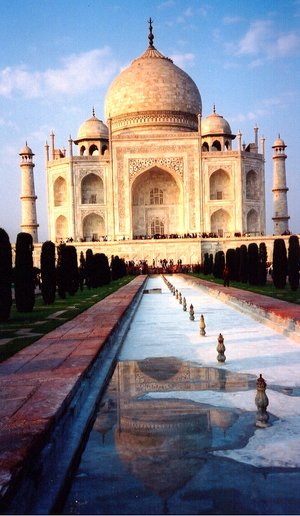
Check out the LINK below AFTER reading this......
Real History of "Taj Mahal"
"The Moghul Emperor Shah Jahan in the memory of his wife Mumtaz Mahal built the Taj Mahal. It was built in 22 years (1631 to 1653) by 20,000 artisans brought to India from all over the world!. Many people believe Ustad Isa of Iran designed it." This is what your guide probably told you if you ever visited the Taj Mahal. This is the same story I read in my history book as a student.
NOW READ THIS.......
No one has ever challenged it except Prof. P. N. Oak, who believes the whole world has been duped. In his book Taj Mahal:
The True Story, Oak says the Taj Mahal is not Queen Mumtaz's tomb but an ancient Hindu temple palace of Lord Shiva (then known as Tejo Mahalaya). In the course of his research Oak discovered that the Shiva temple palace was usurped by Shah Jahan from then Maharaja of Jaipur, Jai Singh.In his own court chronicle, Badshahnama, Shah Jahan admits that an exceptionally beautiful grand mansion in Agra was taken from Jai SIngh for Mumtaz's burial.
The ex-Maharaja of Jaipur still retains in his secret collection two orders from Shah Jahan for surrendering the Taj building. Using captured temples and mansions, as a burial place ! for dead courtiers and royalty was a common practice among Muslim rulers.
For example, Humayun,Akbar, Etmud-ud-Daula and Safdarjung are all buried in such mansions. Oak's
inquiries began with the name of Taj Mahal. He says the term "Mahal" has never been used for a building in
any Muslim countries from Afghanisthan to Algeria. "The unusual explanation that the term Taj Mahal
derives from Mumtaz Mahal was an illogical in atleast two aspects.
Firstly, her name was never Mumtaz Mahal but Mumtaz-ul-Zamani," he writes.
Secondly, one cannot omit the first three letters 'Mum' from a woman's name to derive the remainder as the name for the building."Taj Mahal,he claims, is a corrupt version of Tejo Mahalaya, or Lord Shiva's Palace.
Oak also says the love story of Mumtaz and Shah Jahan is a fairy tale created by court sycophants, blundering historians and sloppy archaeologists. Not a single royal chronicle of Shah Jahan's
time corroborates the love story. Furthermore, Oak cites several documents suggesting the Taj Mahal predates Shah Jahan's era, and was a temple dedicated to Shiva, worshipped by Rajputs of Agra city.
For example,
Prof. Marvin Miller of New York took a few samples from the riverside doorway of the Taj. Carbon dating tests revealed that the door was 300 years older than Shah Jahan.
European traveler Johan Albert Mandelslo,who visited Agra in 1638 (only seven years after Mumtaz's death), describes the life of the city in his memoirs.But he makes no reference to the Taj Mahal being built.
The writings of Peter Mundy,an English visitor to Agra within a year of Mumtaz's death, also suggest the Taj was a noteworthy building well before Shah Jahan's time.
Prof. Oak points out a number of design and architectural inconsistencies that support the belief of the Taj Mahal being a typical Hindu temple rather than a mausoleum.Many rooms in the Taj !Mahal have remained sealed since
Shah Jahan's time and are still inaccessible to the public. Oak asserts they contain a headless statue of Lord Shiva and other objects commonly used for worship rituals in Hindu temples.
Fearing politicalbacklash,Indira Gandhi's government tried to have Prof. Oak's book withdrawn from the bookstores, and hreatened the Indian publisher of the first edition dire consequences. There is only one way to discredit or validate Oak's research.
The current government should open the sealed rooms of the Taj Mahal under U.N. supervision, and let international experts investigate.
Do circulate this to all you know and let them know about this reality.
The below link adds as a visual proof to what is described above.
http://www.stephen-knapp.com/was_the_taj_mahal_a_vedic_temple.htm
Subscribe to:
Posts (Atom)